
Correcting Modern Errors on the Quadrivium
What classical educators need to know.

Hang around classical ed circles long enough, and one will likely hear “We need to teach math and science classically.” What is usually meant by this, is that some kind of classical pedagogy needs to be used in mathematics and the (natural) sciences. But what if to be truly classical—that is, to retrieve the truth once understood and taught by the likes of St. Augustine, Boethius, and St. Thomas—we need to entirely recast our understanding of what the mathematical and natural sciences are? Recovering the Quadrivium is one such 4-fold path, but it is not so easy to recover. No one today has sufficiently done so.1 Recovering the thought of the Medievals is one of my academic goals not merely because it is necessary for classical christian education to be “classical,” but because I believe it to be true. There is still much work to do, and much of what I say probably can be precisioned and clarified further. It is, however, a start in what I hope is the right direction.
The Ancients and Medievals are severely misunderstood by all moderns—both those who reject them and those who seek their wisdom. The shadow of Newton et al looms long and large. Indeed, reading the Medievals is like looking at the sun during a total eclipse; light shines through, but all is dark. Furthermore, it is the moon that is seen, and not the sun at all. If the classical ed (TM) movement is ever to rightly understand the tradition, then we must remove the moon from our eyes. To borrow from a certain well known allegory, we must escape the cave.
In order to escape the cave we must pay special attention to the master philosophers, who, having escaped the cave themselves, will guide us by the hand. An admonishment to the student—shed all that you think that you know of number, ratio, and the quadrivium, they will only weigh you down. The masters understood the liberal arts to be propaedeutic and wrote their treatises accordingly. We will take Boethius and Thomas as our exemplary masters, for there is none better to guide us than the master who coined the very term Quadrivium and the master who exceeded all masters before him. It is also helpful to place the truth in opposition to the insufficient and false so that we may proceed not only by what is but also by what is not. For this purpose we will refer to Jason Farley’s recent post on the Quadrivium.2 I believe him to be quick to thought and a reader of the tradition who wants to learn from our fathers, but I also believe this article to be summarily representative of the modern errors—not of his own fault, but due to the academic mire that is the post-enlightenment age.
Farley writes:
In the classical Christian tradition, education is not first about information but formation—of the soul, of the mind, of society, and of the affections.
While I laud this distinction, in that I would never say that education is about “information,” we should seek for precise understanding of what education is. Education is precisely aimed at in-forming the mind (animus). In other words, the end (final cause) of education is the understanding of all that is as it really is. The formal cause of education, id est, what it is to be educated, is to understand all that is as it is in actuality.
The Quadrivium—the fourfold path of arithmetic, geometry, music (harmonics), and astronomy/cosmology—is one such language through which God’s creation sings His glory.
There are distinctions to be made between music and harmonics as well as between astronomy and cosmology, but we will pass over them. The Quadrivium is not “a language.” A language is (very roughly) a conventional system of signs which signify the first and second acts of the mind: understanding and judgment. Each of the members of the Quadrivium are, as Boethius says, sciences (demonstrated knowledge from principles) which receive their names (that is, their principles) from wisdom (metaphysics).3 The four sciences (and their corresponding arts which bear the same names) are collected under the quadrivium and placed alongside the Trivium, Thomas (referencing Hugh of St. Victor) says, “because those who wanted to learn philosophy were first instructed in [the seven liberal arts].”4 We will define the four sciences below in contrast to Farley’s definitions. Farley continues:
To understand the Quadrivium, we must first set it within the context of the Seven Liberal Arts. […] If the Trivium teaches us how to hear and speak truth well, the Quadrivium helps us to behold, measure, and compare truth through number, ratio, and form.
I will first note that Boethius does not set the Quadrivium within the context of the Trivium, but it can be helpful to understand why they were often joined together (Augustine, in De Ordine, for example, gives his account of Reason personified as maturing in wisdom through the 7 sciences—without, of course giving the names Trivium and Quadrivium). Second, although the Quadrivium does help us behold, measure, et cetera, and as Boethius says, is the path through which those seeking wisdom (again, knowledge of first causes, id est, metaphysics) must first proceed, the sciences are also desired for their own sake. That is, if we desire to understand reality, then we must study all that which is real; the second category of being is quantity and therefore we seek out scientia of quantity. What it is, whether it has species, whether it has individual existence, how it is, etc. are all questions of metaphysics. In answering these questions, Metaphysics provides the principles from which the sciences of arithmetic, geometry, etc. are pursued.
The foundations of this vision were laid by thinkers such as Pythagoras and Plato, who saw the universe not as chaos, but as kosmos—ordered, patterned, intelligible. Pythagoras famously said, “All is number,” not in a reductionist way, but as a recognition that beneath all things lies an order we can perceive.
Not a critique of substance, but I wanted to draw attention to the ambiguity of Pythagoras’ statement. Mathematics historian Jacob Klein offered a translation of Pythagoras’ statement ἀριθμῷ δέ τε μάντ᾽ ἐπέοικεν as all is measurable.5 To avoid misconceptions of what number is, it might also be translated “All is multitude” or “All fits in multitude.” Multitude, as we will see, is a kind of plurality.
Plato’s Timaeus describes the world-soul being formed according to mathematical ratios. Number, for them, was not mere calculation—it was a path to the contemplation of reality as parts and whole.
This is fine.
The Church Fathers and medieval scholars received this vision and baptized it. They saw in the Quadrivium a ladder ascending from earthly observation to divine contemplation and back again to a transformative vision for how life ought to be. Boethius, the Roman Christian philosopher, wrote that mathematics “leads the mind upward from sensible things to eternal realities.” It trains us to real the concrete and abstract.
Boethius’s quote is helpfully clarified by Thomas’ division of the sciences in his commentary on Boethius’ De Trinitate. The speculative intellect is divided by what it knows: physics, mathematics, and metaphysics (divine science). The physical sciences are knowledge of things that exist in matter and cannot be understood apart from matter, id est, their definition (logos/ratio) includes matter e.g., man is rational mortal animal. The mathematical sciences are knowledge of that which exists in matter but can be understood apart from matter, id est, their ratio does not include matter e.g., unity is that by virtue of which things which exist are called one, or again, “point is that which has no part.” Metaphysical science is knowledge of being per se and is therefore of that which is apart from matter and is understood apart from matter. e.g., Potency is that which can be but is not. All knowledge in some way leads back to metaphysical knowledge, or to the first cause.
Thus, each discipline of the Quadrivium reflects a different aspect of number:
This is where the modern errors, which are so prevalent in the water today, start to disperse their confusions in Farley’s article. This division (Number per se, Number in Time, Number in Space, Number in Space and Time) that Farley presents is unbelievably prevalent today and yet is wildly ahistorical. In fact, I have been unable to find references to this division older than the last 25 years—although there are similarly erroneous definitions offered in histories over the last 200 years. For example, “The Century Dictionary” published in 1890 writes “Arithmetic (treating of number in itself), music (treating of applied number), geometry (treating of stationary number), and astronomy (treating of number in motion).” To call all this number obscures the distinction in kinds of quantity—however, the Century dictionary is not pulling “applied number” out of nowhere. They possibly get it from Thomas himself, although, he does not say this of only music but of all intermediate mathematics: “Still others are intermediate, and these apply mathematical principles to natural things; for instance, music, astronomy, and the like.”6
This division is not only ahistorical. It is also entirely in error, and the errors multiply as one attempts to learn the science. Now, Farley intentionally (as good philosophers do) plays with the symbolism, so I do not want to sound pedantic or nit-picky—but even his symbolism is in error because his definitions and principles are in error. He (and everyone attempting to read the tradition today) therefore fails to grasp the actual nature of the medieval symbolism present in so much of their art and literature. Worse, to fail to understand the science is to fail to understand reality. What determines one science from another is what is called its unique (the latin here would be proprium, from which we get proper and property) object. This proper object is not an individual but rather a genus, or category, of different things. Sometimes, we distinguish sciences as a species from its genus. Biology is the science which studies all living things, whereas Zoology only studies animal life or Botany plant life. Other times, sciences are distinguished not as one contained in the other containing but rather as both contained in a higher genus and not contained by the other. Neither Zoology nor Botany are contained in one another but are rather both contained in Biology.
Arithmetic is number in itself—pure, abstract, eternal. It reflects the divine unity and simplicity of God. The number one represents unity; three, the Trinity; seven, completeness. Numbers are not merely tools, but symbols, adjectives of reality, icons through which we discern the mind of the Maker.
Arithmetic is the science of multitudes, what Hugh of St. Victor calls, “discrete quantities.”7 The multitudes which Arithmetic studies Multitude is a plurality composed of unities. Unity is that by which each thing is one. (Euclid Book 7) One is NOT a number, but is rather the measure of multitude (as Thomas says in his commentary on the Metaphysics).8 Simple plurality which is opposed to the unity convertible with being, is a quasi genus of multitude. That unity which takes the rationem of measure is determined to a certain genus: quantity.9 Arithmetic is not the science of multitude in itself. No. Boethius says that Arithmetic is the science of multitudes sunt per se. That is, the proper object of the science of Arithmetic is that species of multitude whose individuals are in themselves.10
Geometry is number in space. It concerns the measurement and relation of shapes and distances. From Euclid to cathedrals, geometry taught the ancients and the medievals that proportion and symmetry are beautiful—and all beauty is a stream flowing from the divine, who is eternal and infinite beauty.
Geometry is the science of magnitudes, or, continuous quantity. A magnitude, according to Boethius, is that which is “joined together in its parts and not distributed in separate parts, such as a tree, a stone, and all the bodies of this world.” Specifically, Geometry is the science of magnitudes that do not move. Magnitudes are not numbers (multitudes). A magnitude does not have in itself that certain quality of indivisibility which is possessed by those things which are measurable by one such as how flock of sheep is measured by one sheep. I will also note that “space” is a completely foreign idea to the ancients. There is only place, and place is determined by the relation of bodies to one another, especially as containing and being contained.11
Distinguishing the proper objects of Arithmetic and Geometry: In short, a continuous quantity is potentially infinitely divisible while a discrete quantity is potentially infinitely augmentable but not infinitely divisible. For example, a line is a continuous quantity: It has no smallest part and can be infinitely divided into 2 lines, 3, 4, etc. Again, a singular sheep is a discrete quantity. It cannot be divided into two sheep, but one sheep can always be added to the last.
Music is number in time. The movement of tones and rhythms according to measure reveals hidden laws of harmony. For Boethius, there were three types of music: musica mundana (the music of the cosmos), musica humana (the harmony of body and soul), and musica instrumentalis (the music we hear). Music, rightly understood, aligns our souls with the order of God’s world because its beauty is enstoried proportionality. Musica Instrumentalis produces Musica Humana by reflecting Musica mundana.
In Music, we consider (to paraphrase Boethius) "those multitudes which have their existence only in relation to another." This means that we are not just considering two, but two precisely inasmuch as it has a relation toward one.12 These relations also can function like absolute multitudes in mathematical operation. Just as we quadruple a multitude by producing its quadruple (i.e. we quadruple two by multiplying two four times), so we can sesquialter six by producing its sesquialter, nine.
Time does not come into the picture.13 Now, motion, when it comes to the various arts and sciences contained under the mathematical science, does in fact play a part. All ancient mathematicians recognized that sound requires motion inorder to exist. To speak roughly, this is something of a truism for the ancients. Everything that is, required motion in order to become. So, Augustine opens his book on music with a discussion of rhythmics and not harmonics, which are distinct sciences that are both contained under the genus of the mathematical science of music, which is the study of multitudes insofar as they are in relation to another—id est, the study of proportion
Astronomy is number in space and time. It tracks the dance of the heavens. The medieval mind saw in the stars not only objects of scientific curiosity but messengers of divine grandeur. Psalm 19 proclaims, “The heavens declare the glory of God.” By studying, enumerating, and measuring the proportions of the movements of the stars, ancient astronomers sought not just prediction, but understanding—wisdom rooted in wonder. They saw in the measured consistency a model for rulers, a model for worshippers, and a liturgy of a creation overflowing with love for its creator.
It is rather, as Boethius says, that science of magnitudes in motion.
Together, these disciplines formed the foundation of imaginative reasoning. In the medieval university the quadrivium were not ends in themselves. They were preparatory for the study of philosophy and theology. They trained the mind to think with clarity and reverence, to see in creation the fingerprints of the Creator. Thomas Aquinas, synthesizing Aristotle and Augustine, taught that these arts were servants of sacred doctrine. They trained the imagination on careful multi-dimensional reasoning, from concrete to abstract and back again,
It is not the imagination that reasons.14 I have already touched on how they are ends unto themselves, and also how they are not. They do indeed train the imagination, that is, our sense knowledge, but they also give us real universal knowledge of how reality is.
The Quadrivium, then, is not obsolete. It is a discipline of attention, training us to perceive the patterned glory of God’s world. It offers more than knowledge—it fosters wisdom, the harmony of truth and love. In an age of fragmentation and noise, the Quadrivium calls us back to order, beauty, and wonder.
Instead of disparaging “knowledge,” I think it better to lift up what knowledge is commonly perceived as. True, immaterial, universal, and certain knowledge is the mode in which man can ascend to the divine. Wisdom is, after all, the highest of all knowledge, and all knowledge in it is harmonious.
In closing, let us remember that the end of Christian learning is not merely to master facts, but to be mastered by the truth that sets us free. The Quadrivium is a path. An overgrown and forgotten path, but still an effulgent and joy-filled path, toward that truth.
Well said.
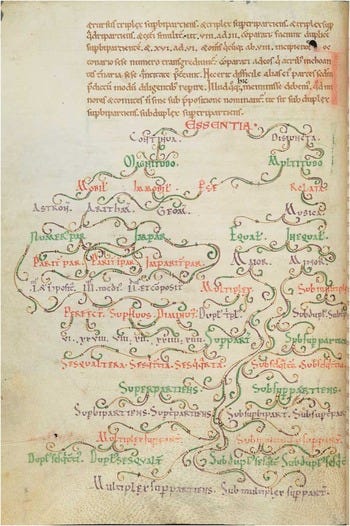
[Image: a student’s diagram, found in a medieval copy of Boethius’ On Arithmetic, of the genus-species divisions of the four mathematical sciences]
A short bio of relevant information: I was classically educated in grade school (both my parents are or have been classical educators), my undergrad is in the seven classical liberal arts from the one school anywhere close to doing the quadrivium correctly, and I have continued to submit myself to the classical and christian philosophic tradition for my master’s degree.
I should note that I have listened to and read Jason Farley for close to two years now, and really like him and he has many good things to say.
Horum igitur, id est quae sunt proprie quaeque suo nomine essentiae nominantur, scientiam sapientia profitetur. De Arithmetica 1.1
Thomas, Commentary on De Trinitate, Chapter 2, Question 5, A1, Reply to Objection 3
One will note in Thomas’ commentary reference to the order of learning: Logic, Mathematics, Natural Philosophy, Ethics, Metaphysics. This does not mean that we teach six year olds everything they need to know about logic! It is better to approach this as the starting point of “university” learning. Students who approach this order have already learned the fundamentals of reading Latin (and whatever their native tongue may be—for the Romans it would have been Latin and Greek, as Augustine discusses in Confessions), can count, and can even reason. Nor is “logic” simply learning fallacies and syllogizing, but rather is the whole of the Organon.
In his lecture: The Concept of Number in Greek Mathematics and Philosophy I believe he says it in various places in differing ways.
Thomas, Commentary on De Trinitate, Chapter 2, Question 5, A3, Reply to Objection 6
In my reading of the tradition it seems that “quantity” is originally synonymous with magnitude, while “quotity” is synonymous with multitude. That the two are just as easily distinguished by continuous measure and discrete measure allows for quotity to drop out of use and for both to fall as species of quantity.
Bk10.L8.2090 “numerus nihil aliud est quam pluralitas et multitudo uno.”
Ibid.
What sense multitudes are said to be, or exist, is difficult and a point of contention between the early Platonist schools and Peripatetics.
Void is considered a scientifically and philosophically disproven notion by the ancients and should still be. To say that there is nothing between two objects and yet somehow that nothing is eg five feet long is absolutely absurd.
Thanks to Matt Petersen for offering this analogy. On analogy, just as we can consider a multitude as it is a certain multitude (e.g. 2, 3, 4, et cetera.) so we can consider a man as he is a certain man, John. We also can consider the man as he is a certain kind of man—son (which designates the relation of a man to his father), father (which designates the relation of a man to his son), et cetera. Likewise, we can consider a multitude as it is a certain kind of multitude e.g. double (which designates the relation 2:1), sesquialter (which designates the relation of 3:2), et cetera. Just as we say that a father or son is a certain kind of man, so too we can say that double, sesquialter, etc. are certain kinds of multitude. Now a father is not a father if he does not have a son (even though as a man he does exist). Likewise, so we say that the sesquialter of two which is three would not exist without its relation to two (even though three as it is itself does exist apart from this relation).
Time, for the ancients, is not a thing that exists. It is really only the measure (or number), of motion.
Thomas will distinguish between particular reason and universal reason. One happens in the corporeal organ that imagination belongs to (brain) the other in the intellect (which is immaterial).
Great stuff overall! I don't mind Farley's take (as you portray it), and find it a lot better than most as far as broad strokes to large audiences go, although his take could be more nuanced. As far as your take goes:
Not at all convinced we should take "ἀριθμῷ δέ τε πάντ᾽ ἐπέοικεν" in any other way except, "but all resembles number" and just explain what ἀριθμός means. I'm also concerned by construing it in an identity sense like, "all is number," because of "ἐπέοικεν". And I would wonder if there is a fuller quote/sentence with context (though Reddit reports one, it is faulty and incorrectly cited), due to the "δέ τε" which would make me thinks it would have originally been a "but and" or "and also" or "this ____ but in addition, this ____" sort of clause. But that is trifling.
I disagree with your comment on time regarding music. To say time doesn't come into the picture, but motion does, and time can't because it is not taken substantially by the ancients and medievals in question here seems a bit faulty. It can be spoken of even if it does not exist as a thing. And especially if we grant that time is the "number of motion with respect to before or after" (Aristotle, Physics IV, as you will have already recognized), it seems to be some major aspect of rhythm and perceived harmonies (where harmony is primarily linear) which does not come into play with Arith. and Geo. thus far in the quad, so is a a distinguisher for music, by which harmonia is best seen. NOW, if we mean harmonia strictly, this is less so, and a study of "multitudes insofar as they are in relation" is a better way to construe it.
Also, I have no problem with the medievals as far as the liberal arts go, especially since that's when we really see things formalized, but I wouldn't mind consulting Presocratics/Plato/Nicomachus/Iamblichus/Plotinus/Aristides Quint. on the quadrivium a bit more. They sometimes conceive of things with differing metaphysics or methods that can be nice to have, especially when thinking about the symbolic side of things, and are majors players in the development of ancient quadrivial stuff. And help when thinking of limit/unlimited. Then again I'm not really a pythagorean nor a neoplatonist in a lot of senses anyway.
I'm glad we agree one isn't a number :)
Thanks for a great take on the quad!
Really appreciate this interaction! I'm, like many, trying to find an education. Much of what you write is a helpful drilling down to the particulars. Also, as I've read through the relevant works, it seems that the conversation and debate is where a significant portion of the wisdom is found. So, here we go!
I agree that I'm not careful with definitions. I'm writing with current vocabulary. Your pull into more precise definitions is appreciated. I do not believe that I severely misunderstand the ancients and medievals, having spent my fair share with them, but I did not write this essay with the precision of the language that they would have. Point taken. Writing post-Heidegger about medievals is a balancing act that I have not mastered. Many readers do not have the metaphysical vocabulary necessary, but that doesn't excuse my sloppy definitions.
Some I will stand behind. I believe words like information have changed meaning in modern English such that they no longer denote what the medievals meant. But over all, I ought to shore up.
And many of your distinctions are exactly what I am working through as I work through the traditions.
At the heart of what I am after is a restoration of the Quadrivium as something other than what we think of as Math and Science curriculum. In the same way the trivium is not grammar and literature curriculum. It is the recovery of the art of knowing. This whole project, for me, began as I worked through Aristotle's divisions of knowledge. The realization that we lack care in our distinctions opened an attic of dust covered books that I have been working my way through in order to understand the quadrivium. Part of writing about it is to sort my own thoughts. As Bacon quipped, writing makes a man exact. But the other part is to find those already having the discussion. So, I'm halfway there (and living on a prayer)
To the meat: Though I am not surprised to find a definition I am using to not be ancient, I am surprised that it is not because it is extremely prevalent. I stepped into a conversation in the present and am, in many ways, reading my way backwards. So I appreciate what you are saying, but I also am stepping into the contemporary conversation and, as is my habit, trying to pull together what I am learning as I go. I also fully admit that much of my reading has focused on alchemical writings as much as philosophical.
I am approaching the quadrivium as a humanist more than a mathematician (to my shame), but, I am looking to understand, so your distinction between discrete quantities and number in itself is interesting. The way I would see that distinction is between the abstract and the particular. The study of arithmetic would be the study of both as well as the study of the relation of the abstract to the particular. Correct? My definition is partial, not incorrect, if I am reading you correctly.
On to Geometry. Yes, space is a foreign concept to the ancients. but it is not to us. So I believe my definition and your definition are a difference of vocabulary. Not to say they are not substantive, and that my vocabulary is not the one in need of refining, but the substance of geometry as the art of enumerating magnitudes (what many would now call space) is at least a starting point. Correct?
Now, music, this is where we may have a disagreement. I'm not sure. I do believe that time is one important aspect of what is being enumerated in music. The divisions of time by rhythm are central to writings on music, as well as the discussions of the music of the spheres. Now, my philosophical definition of time may, perhaps, be what you see as the problem. I'm still unsure about the metaphysical nature of time. I'm stuck between competing voices at the moment and that may be coming through, but the vibrations that produce sound as well as the divisions of rhythm can be neither produced or experienced without time.
On astronomy, I don't disagree with Boethius, but believe astronomy as a quadrivial science, came to include much more than that. Bede's work on the keeping of time has influenced my understanding of astronomy as a broader discipline.
And I simply disagree with Thomas (with sufficient shamefacedness, since I understand I am disagreeing with my superior) on the use of the imagination. Logocentric reason does not hold the central place in reasoning anymore and, as Christ is both the Divine Logos and the Divine Image at the same time, I do not believe we need set asunder the imagination and reason. We are, as a rule, more prone to make the opposite error in our day, so we could use the ballast of The Angelic Doctor, but I stand by my statements about the imagination.
Sir, I appreciate your response immensely! This is an incredibly valuable conversation. Thank you!